When done right, Amazon Sponsored Ads Management does not just drive traffic. It drives the right traffic. It puts your products in front of shoppers who are already looking to buy, reduces wasted spend, and contributes directly to revenue growth.
In this guide, we break down everything you need to know about managing Amazon Sponsored Ads effectively, from campaign structure to bid strategy, so you can lower your ACoS and start building real, scalable sales momentum.
What Is Amazon Sponsored Ads Management?
Amazon Sponsored Ads Management refers to the end-to-end process of planning, setting up, optimizing, and scaling paid advertising campaigns on Amazon. It covers three core ad types that work together to maximize your brand’s reach across the marketplace.
- Sponsored Products remain the most popular advertising format on Amazon. These are cost-per-click (CPC) ads that appear directly in Amazon search results and on product detail pages. They are keyword-driven and designed to push individual listings to the top of relevant searches.
- Sponsored Brands help build brand recognition by showcasing your logo, a custom headline, and multiple products at the top of search results. These are available to brand-registered sellers and are highly effective for capturing shopper attention early in the buying journey.
- Sponsored Display ads allow you to reach audiences both on and off Amazon. They are used for retargeting shoppers who viewed your product but did not purchase, making them a powerful tool for recovering lost conversions.
Together, these three formats form the foundation of a complete Amazon Sponsored Ads strategy that covers every stage of the customer journey, from discovery to decision.
Why ACoS Matters (and What a Good Number Looks Like)
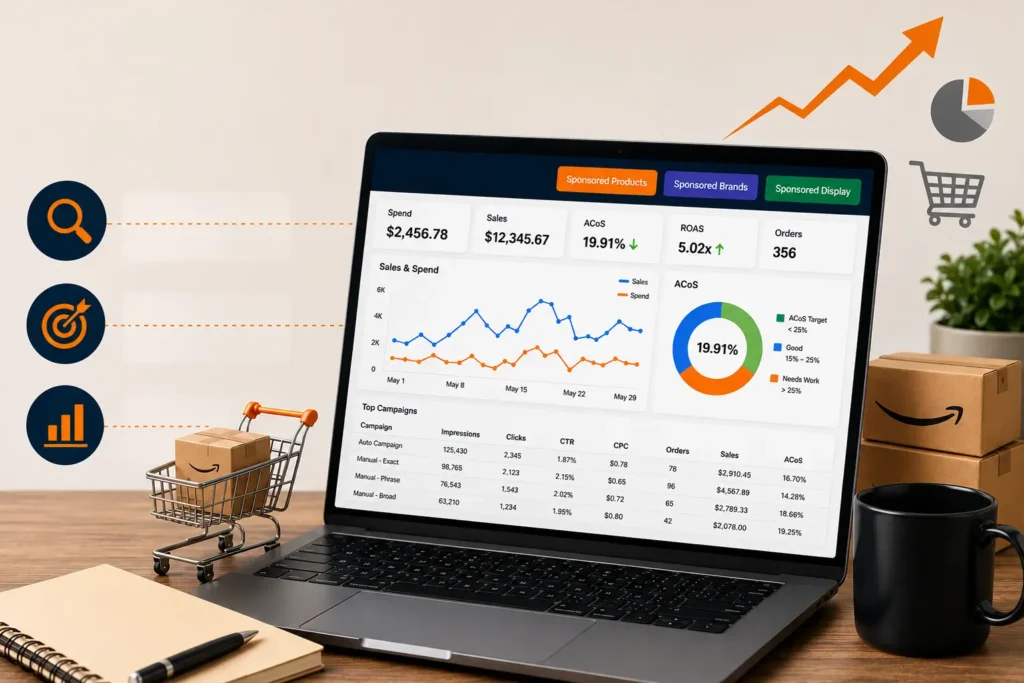
ACoS, which stands for Advertising Cost of Sale, is the single most important metric in Amazon PPC. It tells you what percentage of your ad-attributed sales you are spending on advertising.
ACoS Formula: (Ad Spend ÷ Ad Revenue) × 100
For instance, if you invest $200 in advertising and earn $1,000 in sales attributed to those ads, your ACoS would be 20%.
A “good” ACoS depends on your product margins, but as a general benchmark:
- Below 15%: Highly profitable, excellent campaign efficiency
- 15% to 30%: Healthy range for most product categories
- 30% to 50%: Acceptable during launch or ranking phases
- Above 50%: A clear signal that campaigns need optimization
The goal of professional Amazon PPC management is to bring ACoS down to a point where advertising becomes a growth tool, not a cost drain. This is achieved through precise keyword targeting, smart bid management, and ongoing campaign refinement.
How to Structure Amazon PPC Campaigns for Maximum Performance
Campaign structure is where most sellers go wrong. A poorly organized campaign makes it nearly impossible to track performance, control spend, or scale what is working. Here is the structure that works:
1. Separate Auto and Manual Campaigns
Start with automatic campaigns to let Amazon’s algorithm discover which search terms convert for your product. Use this data to feed your manual campaigns with proven, high-performing keywords.
Automatic campaigns are great for research. Manual campaigns are where you scale profitably.
2. Organize by Match Type
In your manual campaigns, segment keywords by match type (Broad, Phrase, and Exact) into separate ad groups or campaigns. This gives you granular control over bids and prevents high-performing exact-match keywords from getting diluted by broad traffic.
3. One Product Per Ad Group
Avoid mixing multiple products in a single ad group. When each ad group focuses on one ASIN, you can track performance clearly, adjust bids accurately, and write more relevant ad copy.
4. Use Negative Keywords Consistently
Negative keywords ensure your ads are shown only to users searching for relevant terms. Failing to add negatives is one of the biggest causes of wasted spend in Amazon advertising. Review your search term reports weekly and build a strong negative keyword list from day one.
Keyword Targeting: The Engine Behind Every Profitable Campaign
Keyword strategy is the core of any successful Amazon advertising campaign. The right keywords connect your product with high-intent buyers. The wrong ones drain your budget on shoppers who will never convert.
Start With Thorough Keyword Research
Use a combination of Amazon’s own auto-campaign data, keyword research tools, and competitor analysis to build your initial keyword list. Look for terms with strong search volume and clear purchase intent, not just broad, generic phrases.
Prioritize High-Intent, Long-Tail Keywords
Long-tail keywords (those with three or more words) tend to have lower competition, lower CPCs, and higher conversion rates because they reflect more specific buyer intent. For example, “waterproof hiking boots for men size 10” converts far better than just “boots.”
Balance Branded and Non-Branded Keywords
Non-branded keywords capture new customers who do not yet know your brand. Branded keywords defend your territory and prevent competitors from stealing shoppers who are already familiar with you. A well-rounded strategy includes both.
To learn more about how keyword-driven ad management drives product visibility, read our blog on How Amazon Sponsored Ads Management Helps You Increase Product Visibility.
Bid Optimization: Spending Smarter, Not More
Getting keyword targeting right is only half the equation. Bid optimization helps you strike the right balance by paying enough to secure ad placements without cutting into your profit margins.
Understand Placement Multipliers
Amazon allows you to set bid adjustments for Top of Search, Rest of Search, and Product Pages placements. Top of Search typically delivers the highest conversion rates but also the most competition. Use placement data to understand where your conversions are coming from and bid accordingly.
Use Dynamic Bidding Strategically
Amazon offers three bidding options: Dynamic Bids Down Only, Dynamic Bids Up and Down, and Fixed Bids. For most sellers, starting with Down Only while your campaigns gather data is the safest approach. As you identify consistently converting keywords, you can switch to Up and Down to capture more volume.
Review and Adjust Bids Regularly
Bids should not be set once and forgotten. Conduct weekly bid reviews for your high-spend, high-converting keywords. Increase bids on keywords generating profitable sales. Reduce or pause bids on keywords with high spend and low conversion.
Key Metrics Every Amazon Seller Must Track
Effective Amazon Sponsored Ads Management is driven by data. These are the metrics that matter most:
- ACoS (Advertising Cost of Sale): Your primary efficiency metric. Lower is better, within the context of your margins.
- ROAS (Return on Ad Spend): The inverse of ACoS, showing how many dollars in revenue you generate per dollar spent. A ROAS of 4x means every $1 in ad spend generates $4 in sales.
- CTR (Click-Through Rate): The percentage of impressions that result in clicks. A low CTR often signals weak ad relevance or poor placement.
- CVR (Conversion Rate): The percentage of clicks that result in purchases. A low CVR points to product listing issues, pricing problems, or misaligned keyword targeting.
- CPC (Cost Per Click): What you pay each time someone clicks your ad. Monitor CPC by keyword to identify where you can tighten bids without losing visibility.
- Impressions: The number of times your ad is shown. Low impressions suggest your bids or budget are too restrictive.
Tracking these metrics consistently gives you the visibility to make smart, data-driven decisions rather than guesswork.
Common Amazon PPC Mistakes That Kill Profitability
Even experienced sellers make these mistakes. Knowing them is half the battle.
- Setting campaigns and walking away. Amazon PPC is not passive. Campaigns that are not actively monitored will drift, waste budget, and underperform over time. Regular optimization is non-negotiable.
- Targeting too broadly too soon. Launching with only broad-match keywords before you have conversion data leads to high spend and low returns. Start more controlled, then expand once you know what converts.
- Ignoring the search term report. This report shows the actual search queries that triggered your ads. It is the most valuable optimization tool you have. Mine it weekly for new keyword opportunities and negative keyword additions.
- Running ads on poorly optimized listings. No amount of ad spend will compensate for a listing with weak images, thin bullet points, or unclear value. Your listing must convert before your campaigns can scale profitably.
- No budget allocation strategy. Many sellers distribute budgets evenly across campaigns regardless of performance. High-converting campaigns deserve more budget. Underperforming campaigns should be restricted until optimized or paused.
For a broader look at how Amazon services work together to grow your business, check out our post on Essential Amazon Seller Services to Grow Your Online Business.
Sponsored Products vs. Sponsored Brands vs. Sponsored Display: Which Should You Use?
Each ad type serves a distinct purpose, and the most effective strategies use all three in a coordinated way.
- Sponsored Products are the starting point for almost every seller. They are the fastest path to visibility on search results and the easiest to set up and test. Prioritize these first.
- Sponsored Brands become important once you have a few products performing well and want to build brand equity. They drive awareness at the top of search and are particularly effective during high-traffic periods like Prime Day and peak seasonal events.
- Sponsored Display ads are best used for retargeting, re-engaging shoppers who viewed your product but did not buy. They extend your reach beyond Amazon and help recover lost conversions at relatively low cost.
A complete Amazon Sponsored Ads management approach integrates all three formats into a unified strategy aligned with your growth goals.
How Professional Amazon Sponsored Ads Management Drives Better Results
Managing Amazon ads in-house is possible, but it requires significant time, expertise, and constant attention. Many sellers find that the complexity of campaign management pulls focus away from other critical parts of their business, including product sourcing, inventory planning, and customer service. Pairing your ad campaigns with professional Amazon Account Management ensures every part of your Amazon presence is working together toward the same growth goals.
At Digi Periscope, we work with Amazon sellers to build and manage campaigns that are structured for profitability from day one. Our approach combines deep keyword research, smart campaign architecture, ongoing bid optimization, and transparent performance reporting, all designed to lower your ACoS, improve ROAS, and scale your sales sustainably.
Whether you are just starting with Amazon advertising or looking to fix campaigns that are not delivering, a data-driven management approach makes a measurable difference.
Conclusion
Amazon Sponsored Ads Management is not about spending more. It is about spending smarter. Every dollar of your ad budget should be working toward a clear outcome: getting your products in front of the right shoppers, at the right time, at a cost that keeps your business profitable.
The sellers who win on Amazon are not necessarily those with the biggest budgets. They are the ones with the most disciplined campaign structures, the most targeted keyword strategies, and the most consistent optimization habits.
Start by getting your campaign structure right. Build your keyword list with intent in mind. Review your metrics weekly and act on the data. And if the complexity becomes a barrier, consider working with an experienced Amazon PPC team who can manage and scale your ads while you focus on growing your business.
Frequently Asked Questions
What is Amazon Sponsored Ads Management?
Amazon Sponsored Ads Management is the process of setting up, optimizing, and scaling paid advertising campaigns on Amazon, including Sponsored Products, Sponsored Brands, and Sponsored Display ads, to improve product visibility, drive traffic, and increase sales profitably.
What is a good ACoS for Amazon ads?
A healthy ACoS typically falls between 15% and 30%, though the right target depends on your product margins. During product launch phases, a higher ACoS is acceptable as you gather data and build sales velocity.
How long does it take to see results from Amazon Sponsored Ads?
Initial data starts coming in within the first week of a campaign going live. Meaningful optimization insights typically emerge after 2 to 4 weeks. Sustained, profitable results usually develop over 2 to 3 months of consistent management.
What is the difference between ACoS and ROAS?
ACoS measures ad spend as a percentage of ad revenue (lower is better). ROAS measures how much revenue you earn per dollar spent on ads (higher is better). Both track campaign efficiency from different angles and should be monitored together.
Should I run automatic or manual Amazon PPC campaigns?
Both serve different purposes. Automatic campaigns help you discover new converting keywords by letting Amazon’s algorithm match your ads to relevant searches. Manual campaigns give you precise control over which keywords you target and how much you bid. The most effective strategy uses both.
How do I reduce wasted spend in Amazon PPC campaigns?
The most effective ways to reduce wasted spend are to add negative keywords regularly, segment campaigns by match type, review search term reports weekly, and pause or reduce bids on keywords with high spend and low conversions.
Can small sellers benefit from Amazon Sponsored Ads?
Yes. Amazon Sponsored Ads are scalable and work for sellers at all levels. With a modest, well-managed budget focused on high-intent keywords, small sellers can generate meaningful visibility and sales without overspending.
Ready to lower your ACoS and build campaigns that actually grow your business? Explore our Amazon Sponsored Ads Management Services or get in touch with Digi Periscope today.